Table of Contents
1. Introduction
Chinese Spelling Correction (CSC) is a critical NLP task focused on detecting and correcting spelling errors in Chinese text. It serves as a foundational component for applications like Named Entity Recognition, Optical Character Recognition (OCR) post-processing, and search engine optimization. Traditional state-of-the-art methods frame CSC as a sequence tagging problem, fine-tuning models like BERT to map erroneous characters to correct ones. However, this paper identifies a fundamental limitation in this approach: it conditions corrections excessively on the error pattern itself, rather than the overall sentence semantics, leading to poor generalization on unseen errors.
2. Methodology
2.1. The Flaw of Sequence Tagging
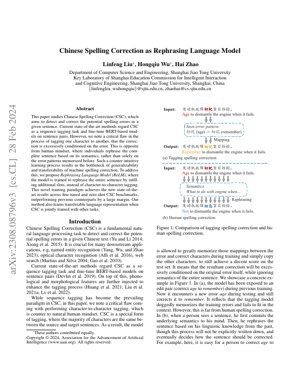
The paper argues that the prevalent sequence tagging paradigm is counter-intuitive to human correction. Humans understand the semantics of a sentence first and then rephrase it correctly based on linguistic knowledge, not by memorizing direct character mappings. Tagging models, however, can achieve high scores by simply memorizing frequent error-correct pairs from training data and copying unchanged characters, failing to adapt to context when novel errors appear. Figure 1 in the PDF illustrates this with an example where a model incorrectly changes "age" to "remember" based on a memorized pattern, while a human would correct it to "not" based on sentence meaning.
2.2. The ReLM Framework
To address this, the authors propose the Rephrasing Language Model (ReLM). Instead of character-to-character tagging, ReLM is trained to rephrase the entire input sentence. The source sentence is encoded into a semantic representation. The model then generates the corrected sentence by "infilling" specified mask slots within this semantic context. This forces the model to rely on global sentence understanding rather than localized error memorization.
3. Technical Details
3.1. Mathematical Formulation
Given a source sentence $X = \{x_1, x_2, ..., x_n\}$ containing potential errors, the goal is to generate the corrected target sentence $Y = \{y_1, y_2, ..., y_m\}$. In the tagging paradigm, the objective is often modeled as $P(Y|X) = \prod_{i=1}^{n} P(y_i | x_i, \text{context})$, heavily tying $y_i$ to $x_i$.
ReLM reformulates this. It first creates a partially masked version of $X$, denoted $X_{\text{mask}}$, where some tokens (potentially errors) are replaced with a special [MASK] token. The training objective is to reconstruct $Y$ from $X_{\text{mask}}$ based on the full context:
$$P(Y|X) \approx P(Y | X_{\text{mask}}) = \prod_{j=1}^{m} P(y_j | X_{\text{mask}}, y_{ ReLM is built upon a pre-trained BERT encoder. The input sentence is encoded by BERT. For generation, a decoder (or a masked language modeling head) is used to predict the tokens for the masked positions auto-regressively or in parallel, depending on the specific infilling strategy. The model is fine-tuned on parallel corpora of erroneous and correct sentences. ReLM was evaluated on standard CSC benchmarks like SIGHAN 2013, 2014, and 2015. The results show that ReLM achieves new state-of-the-art performance, significantly outperforming previous sequence tagging-based models (e.g., models incorporating phonological features like SpellGCN). The performance gains are attributed to its superior ability to handle context-dependent corrections. A critical test was zero-shot performance on datasets containing error patterns not seen during training. ReLM demonstrated markedly better generalization compared to tagging models. This is direct evidence that its rephrasing objective leads to learning more transferable linguistic knowledge rather than superficial error mappings. Framework: To evaluate a CSC model's robustness, we propose a two-axis analysis: Memorization vs. Understanding and Context Sensitivity. Case Study (No-Code): Consider the example from the PDF: Input: "Age to dismantle the engine when it fails." A tagging model trained on the pair ("age" -> "remember") might output "Remember to dismantle...", incorrectly applying the memorized rule. A human or ReLM, understanding the semantics (a suggestion about engine failure), would likely output "Not to dismantle..." or "Do not dismantle...". This case tests the model's ability to override memorized patterns with contextual understanding, a key differentiator for ReLM. The rephrasing paradigm of ReLM has promising applications beyond CSC: Core Insight: The paper's fundamental breakthrough isn't just a new SOTA score; it's a philosophical correction to how we model language repair. The authors correctly diagnose that treating CSC as a "transcription error" problem (tagging) is a category mistake. Language correction is inherently a generative, meaning-aware task. This aligns with broader trends in AI moving from discriminative to generative models, as seen in the shift from classification CNNs to image-generation models like DALL-E or paradigm-defining frameworks like CycleGAN (Isola et al., 2017), which reframed image translation as a cycle-consistent reconstruction problem rather than paired pixel mapping. Logical Flow: The argument is razor-sharp: 1) Show that current methods work but for the wrong reasons (memorization). 2) Identify the root cause (the tagging objective's myopia). 3) Propose a cognitively plausible alternative (rephrasing). 4) Validate that this alternative not only works but solves the identified flaw (better generalization). The use of the zero-shot test is particularly elegant—it's the experimental equivalent of a knockout punch. Strengths & Flaws: The primary strength is conceptual elegance and empirical validation. The rephrasing objective is more aligned with the true nature of the task. However, the paper's potential flaw is underspecifying the operationalization of "rephrasing." How are mask slots chosen? Is it always a one-to-one infilling, or can it handle insertions/deletions? The computational cost of generation vs. tagging is also likely higher, which is only hinted at. While they cite resources like the Stanford NLP course for foundational Transformer knowledge, a deeper comparison with encoder-decoder models for text revision (like T5) would have strengthened the positioning. Actionable Insights: For practitioners: Immediately deprioritize pure tagging models for any language correction task requiring context. The ReLM paradigm is the new baseline. For researchers: This work opens the door. The next steps are clear: 1) Scale: Apply this objective to decoder-only LLMs (e.g., instruct-tune GPT-4 for correction). 2) Generalize: Test this on grammatical error correction (GEC) for English and other languages—the potential is huge. 3) Optimize: Develop more efficient infilling strategies to reduce the latency overhead. This paper isn't the end of the story; it's the compelling first chapter of a new approach to building robust, human-like language editing systems.3.2. Model Architecture
4. Experiments & Results
4.1. Benchmark Performance
4.2. Zero-Shot Generalization
5. Analysis Framework & Case Study
6. Future Applications & Directions
7. References
8. Expert Analysis & Insights