Table of Contents
1. Introduction
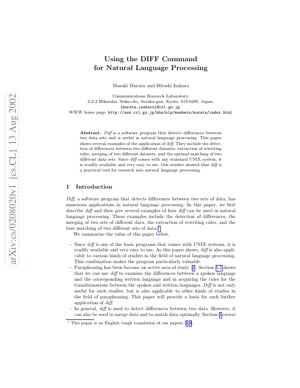
This paper investigates the utility of the Unix diff command, a fundamental tool for detecting differences between files, within the domain of Natural Language Processing (NLP). The authors, Murata and Isahara, argue that diff's simplicity, universal availability on Unix systems, and core functionality make it a surprisingly potent and practical instrument for a range of NLP research tasks beyond simple file comparison.
The paper's value proposition rests on three pillars: demonstrating diff's immediate applicability to NLP, showcasing its use in paraphrasing studies (e.g., spoken vs. written language transformation), and extending its conventional use to novel tasks like data merging and optimal matching.
2. DIFF and MDIFF
The standard diff command performs a line-by-line comparison of two text files, outputting the lines that differ. For example, comparing "I go to school." and "I go to university." yields:
< school.
> university.
The authors introduce a more readable and functional variant called mdiff, which utilizes the -D option of diff to merge files and presents the output in a human-friendly format:
I
go
to
;===== begin =====
school.
;-----------------
university.
;===== end =====
This format clearly demarcates common sequences and divergent sections. Crucially, mdiff output is lossless; the original files can be perfectly reconstructed, making it a form of informational compression.
3. Applications in Natural Language Processing
3.1 Detection of Differences
The most straightforward application is comparing different versions of textual data. This is foundational for tasks like evaluating the output of machine translation systems against human references, tracking edits in collaborative writing, or identifying variations between document drafts.
3.2 Extraction of Rewriting Rules
By systematically applying diff to aligned pairs of sentences (e.g., a formal sentence and its paraphrased version, or a spoken utterance and its written transcript), one can automatically extract potential rewriting rules. The differences highlighted by diff directly point to the lexical, syntactic, or stylistic transformations applied. This provides a data-driven method for building paraphrase resources or studying dialectal and register shifts, aligning with active research areas noted in paraphrasing studies.
4. Merging and Optimal Matching
4.1 Merging Two Datasets
The mdiff output inherently represents a merge of two input sequences, preserving all information. This can be applied to tasks like combining different annotations of the same text or integrating complementary data sources while maintaining a clear audit trail of their origins.
4.2 Optimal Matching
The paper posits that diff's underlying algorithm, which finds the Longest Common Subsequence (LCS), is essentially solving an optimal matching problem between two sequences. This insight allows diff to be repurposed for tasks like aligning a research paper with its corresponding presentation slides or matching questions to candidate answers in a QA system, where the goal is to find the best correspondence between elements of two sets.
5. Core Insight & Analysis
Core Insight: Murata and Isahara's work is a masterclass in lateral tooling. They identify the Unix diff command not as a mere file utility, but as a robust, domain-agnostic algorithm for sequence alignment and difference analysis—a core subroutine in many NLP pipelines. This reframing is powerful because it bypasses the need for custom, complex code, leveraging a battle-tested, optimized tool that is already in every researcher's toolkit.
Logical Flow: The argument progresses elegantly from the mundane (showing diff output) to the insightful (introducing mdiff for human-readable merges) to the innovative (applications in rule extraction and optimal matching). The logical leap from "difference detector" to "optimal sequence aligner" is the paper's critical pivot, connecting a simple command to fundamental computer science concepts like the LCS problem, which is also the backbone of tools like the gestalt pattern matching used in the Python difflib library.
Strengths & Flaws: The primary strength is undeniable pragmatism. In an era increasingly dominated by large, opaque neural models, this paper champions lightweight, interpretable, and efficient methods. It lowers the barrier to entry for prototyping alignment and difference tasks. However, its major flaw is its technical ceiling. Diff operates on lines or characters and uses a basic LCS algorithm. It lacks the sophistication of modern, learned similarity metrics or alignment models like those based on transformer architectures (e.g., BERTScore) or dynamic programming with complex cost functions (like the Levenshtein distance with affine gaps for better edit sequence modeling). It cannot handle semantic similarity where surface forms differ greatly, a limitation highlighted by the evolution of paraphrase detection benchmarks like MRPC.
Actionable Insights: For practitioners, this paper is a reminder to audit your existing toolkit before building anew. Before writing a custom aligner, check if diff, difflib, or their underlying algorithms can solve 80% of the problem. For researchers, it suggests a fertile ground: Can the principles of diff be augmented with learned embeddings? Imagine a "semantic diff" where the LCS is computed not on characters but on vector representations from a model like Sentence-BERT, enabling alignment based on meaning. This hybrid approach could marry the efficiency and transparency of algorithmic methods with the semantic power of neural networks, a direction seen in contemporary research on efficient text matching.
6. Technical Details & Framework
The core algorithm powering diff is the solution to the Longest Common Subsequence (LCS) problem. Given two sequences $X = [x_1, x_2, ..., x_m]$ and $Y = [y_1, y_2, ..., y_n]$, the LCS is found using dynamic programming. Let $c[i, j]$ be the length of the LCS of prefixes $X[1..i]$ and $Y[1..j]$. The recurrence relation is:
$c[i,j] = \begin{cases} 0 & \text{if } i = 0 \text{ or } j = 0 \\ c[i-1, j-1] + 1 & \text{if } i, j > 0 \text{ and } x_i = y_j \\ \max(c[i, j-1], c[i-1, j]) & \text{if } i, j > 0 \text{ and } x_i \ne y_j \end{cases}$
Analysis Framework Example (Non-Code): Consider a paraphrasing study. The framework involves:
1. Data Pairing: Create aligned pairs (source sentence, paraphrased sentence).
2. Preprocessing: Tokenize sentences into sequences of words or subwords.
3. Diff Execution: Feed the token sequences for each pair to diff or a custom LCS function.
4. Rule Hypothesis Generation: Analyze the output. A change from "purchase" to "buy" suggests a synonym replacement rule. A change in word order suggests a syntactic transformation.
5. Validation & Generalization: Manually or statistically validate the hypothesized rules across a larger corpus to filter noise and establish reliability.
Experimental Implication: The paper's "experiments" are demonstrated use cases. The alignment of a paper and its slides serves as a qualitative result, showing how diff can map section headers to slide titles and bullet points to paragraphs. The output itself is the primary "chart"—a side-by-side or merged view that visually validates the matching.
7. Future Applications & Directions
The conceptual framework of diff remains highly relevant, but its implementation must evolve. Future directions include:
- Semantic and Multimodal Diff: Extending the LCS paradigm to operate on semantic embeddings (from models like OpenAI's embeddings or Cohere's embed) for aligning texts with different surface forms. Further, applying similar alignment algorithms to multimodal sequences (e.g., aligning video frames with audio transcripts or image regions with descriptive captions).
- Integration with Version Control for Model Weights: Inspired by
diff's role in code version control (Git), developing efficient "diffs" for neural network weights to track changes, merge fine-tuned models, or diagnose training issues, a nascent area explored in research on model merging and editing. - Enhanced Edit Pattern Recognition: Moving beyond simple insert/delete, using the output of sequence alignment to train classifiers that recognize higher-order edit types (e.g., "formality change," "simplification," "elaboration") for automated writing assistance and educational technology.
- Real-Time Collaborative NLP: Using operational transformation (OT) or conflict-free replicated data type (CRDT) algorithms, which are sophisticated relatives of diff, for real-time collaborative text editing and annotation in NLP tools, ensuring consistency across user contributions.
8. References
- Murata, M., & Isahara, H. (2002). Using the DIFF Command for Natural Language Processing. arXiv preprint cs/0208020.
- Androutsopoulos, I., & Malakasiotis, P. (2010). A survey of paraphrasing and textual entailment methods. Journal of Artificial Intelligence Research, 38, 135-187. (Represents the active area of paraphrasing studies alluded to in the paper).
- Hunt, J. W., & McIlroy, M. D. (1976). An algorithm for differential file comparison. Bell Laboratories Technical Report. (The classic algorithm underlying many
diffimplementations). - Zhang, T., Kishore, V., Wu, F., Weinberger, K. Q., & Artzi, Y. (2019). BERTScore: Evaluating Text Generation with BERT. arXiv preprint arXiv:1904.09675. (Example of a modern, learned metric for text matching that addresses semantic similarity).
- Git. (n.d.). Git - About Version Control. Retrieved from https://git-scm.com/book/en/v2/Getting-Started-About-Version-Control. (The most prominent real-world system built around diff/patch concepts).