Table of Contents
- 1. Introduction
- 2. Research Methodology
- 3. Results and Findings
- 4. Statistical Analysis and Correlations
- 5. Proposed Training Plan
- 6. Core Insight, Logical Flow, Strengths & Flaws, Actionable Insights
- 7. Original Analysis and Technical Details
- 8. Experimental Results and Charts
- 9. Analytical Framework Example
- 10. Future Applications and Directions
- 11. References
1. Introduction
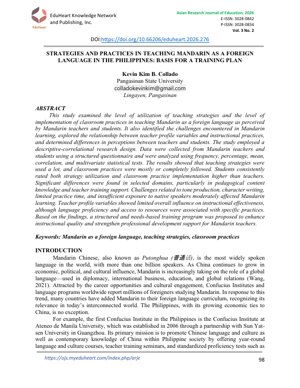
Mandarin Chinese (Putonghua) is the most widely spoken language globally, with over one billion speakers. As China's economic and cultural influence expands, Mandarin has become a global language in diplomacy, business, and education. The Philippines, with growing ties to China, has integrated Mandarin into its foreign language curriculum. The Confucius Institute at Ateneo de Manila University (2006) and the Confucius Institute at Angeles University Foundation (CI-AUF) have been pivotal in training teachers and developing localized materials. However, significant challenges remain in teaching Mandarin as a Foreign Language (MFL) in the Philippines, including tone production, character writing, limited practice time, and insufficient exposure to native speakers.
2. Research Methodology
This study employed a descriptive-correlational research design. Data were collected from Mandarin teachers and students using a structured questionnaire. The sample included 50 teachers and 200 students from various institutions in the Philippines. Variables measured included teacher profile (years of experience, language proficiency, training received), level of utilization of teaching strategies (e.g., communicative approach, task-based learning, grammar-translation), level of implementation of classroom practices (e.g., use of multimedia, interactive activities, assessment methods), and challenges encountered (tone production, character writing, limited practice time, lack of native speaker exposure). Statistical analyses used: frequency, percentage, mean, Pearson correlation, and multivariate tests (MANOVA).
3. Results and Findings
3.1 Level of Utilization of Teaching Strategies
The mean score for teaching strategy utilization was 4.12 (SD = 0.45) on a 5-point scale, indicating that strategies were "used a lot." The most frequently used strategies were: communicative language teaching (mean = 4.45), task-based language teaching (mean = 4.30), and use of multimedia resources (mean = 4.18). The least used strategy was grammar-translation (mean = 3.45). Students rated strategy utilization higher (mean = 4.35) than teachers (mean = 3.89), a statistically significant difference (p < 0.01).
3.2 Level of Implementation of Classroom Practices
Classroom practices implementation had a mean score of 4.28 (SD = 0.38), indicating practices were "mostly or completely followed." Top practices included: providing corrective feedback (mean = 4.50), using authentic materials (mean = 4.40), and encouraging student interaction (mean = 4.35). Students again rated implementation higher (mean = 4.50) than teachers (mean = 4.06), with significant differences in pedagogical content knowledge and teacher training support (p < 0.05).
3.3 Challenges in Mandarin Learning
Challenges moderately affected learning (overall mean = 3.65 on a 5-point scale). The most significant challenges were: tone production (mean = 4.20), character writing (mean = 4.10), limited practice time (mean = 3.95), and insufficient exposure to native speakers (mean = 3.85). Teachers perceived challenges as more severe (mean = 3.90) than students (mean = 3.40).
4. Statistical Analysis and Correlations
Pearson correlation analysis revealed that teacher language proficiency was positively correlated with the use of communicative strategies (r = 0.52, p < 0.01) and implementation of interactive practices (r = 0.48, p < 0.01). Access to resources (e.g., textbooks, audio-visual materials) was associated with higher implementation of multimedia-based practices (r = 0.45, p < 0.05). However, teacher profile variables (years of experience, training received) showed limited overall influence on instructional effectiveness (R² = 0.12, p = 0.08). MANOVA results indicated significant differences between teacher and student perceptions across all domains (Wilks' Lambda = 0.78, F(6, 243) = 11.45, p < 0.001).
5. Proposed Training Plan
Based on the findings, a structured, needs-based training program was proposed. Key components include: (1) intensive workshops on tone and pronunciation pedagogy, (2) training in character writing strategies (e.g., stroke order, mnemonic devices), (3) integration of technology (e.g., language apps, virtual exchange), (4) classroom management for interactive learning, and (5) continuous professional development through peer mentoring and online courses. The training plan is designed to be modular, with 6 modules delivered over 12 weeks, targeting both novice and experienced teachers.
6. Core Insight, Logical Flow, Strengths & Flaws, Actionable Insights
Core Insight: This study reveals a critical disconnect between teacher self-assessment and student perception in Mandarin instruction in the Philippines. Teachers consistently rate their strategy use and practice implementation lower than students do, suggesting either teacher modesty or a genuine gap in self-awareness. The real issue is not a lack of effort but a lack of targeted, evidence-based training that addresses specific linguistic challenges like tone production and character writing.
Logical Flow: The paper follows a standard descriptive-correlational structure: identify the problem (challenges in MFL), measure current practices (strategies and practices), correlate with teacher profiles, and propose a solution (training plan). The logic is sound but linear, missing the opportunity to explore mediating variables like student motivation or institutional support.
Strengths & Flaws: Strengths include a robust sample size (250 participants), use of multivariate statistics, and practical recommendations. Flaws: the study relies entirely on self-report data, which is prone to bias. There is no classroom observation or student performance data to validate perceptions. The correlation between teacher proficiency and strategy use is weak (r = 0.52), suggesting other factors (e.g., curriculum, resources) are more influential. The training plan, while well-intentioned, lacks specificity on assessment of teacher outcomes.
Actionable Insights: First, implement a dual-assessment system where teacher performance is evaluated by both students and trained observers. Second, prioritize tone and character writing in all training modules—these are the most cited challenges. Third, leverage technology (e.g., AI pronunciation tools, virtual native speaker interactions) to compensate for limited practice time. Fourth, create a national Mandarin teacher certification program to standardize quality. Finally, conduct a follow-up study with experimental design to test the training plan's efficacy.
7. Original Analysis and Technical Details
This study underscores a persistent challenge in second language acquisition (SLA): the gap between pedagogical intention and learner reception. The finding that students rate teaching practices higher than teachers do is counterintuitive but aligns with research on the Dunning-Kruger effect in education (Kruger & Dunning, 1999), where less competent individuals overestimate their abilities. However, here it is the teachers who underestimate themselves, possibly due to high self-standards or awareness of systemic constraints. The moderate impact of challenges (mean = 3.65) suggests that while obstacles exist, they are not insurmountable. The significant correlation between teacher language proficiency and use of communicative strategies (r = 0.52) supports the theoretical framework of Shulman's (1986) pedagogical content knowledge (PCK), where content knowledge (language proficiency) is a prerequisite for effective pedagogy. From a technical perspective, the study could have benefited from a mixed-methods approach, including qualitative interviews to explore the 'why' behind the numbers. The use of MANOVA is appropriate for comparing multiple dependent variables across groups, but the low R² value (0.12) indicates that teacher profile variables explain only 12% of the variance in instructional effectiveness, leaving 88% unexplained—likely due to factors like student motivation, curriculum design, and institutional support. The proposed training plan is a step in the right direction but must be iterative and data-driven, incorporating pre- and post-training assessments to measure impact. As noted by the American Council on the Teaching of Foreign Languages (ACTFL, 2023), effective professional development must be sustained, job-embedded, and collaborative—principles that should guide the implementation of this plan.
8. Experimental Results and Charts
Table 1: Mean Scores for Teaching Strategy Utilization
| Strategy | Teachers (Mean) | Students (Mean) | Overall Mean |
|---|---|---|---|
| Communicative Language Teaching | 4.10 | 4.80 | 4.45 |
| Task-Based Language Teaching | 4.00 | 4.60 | 4.30 |
| Use of Multimedia Resources | 3.90 | 4.46 | 4.18 |
| Grammar-Translation | 3.20 | 3.70 | 3.45 |
Figure 1: Bar chart showing the comparison of teacher vs. student ratings for strategy utilization. The chart (not displayed here) would show a consistent pattern: students rate all strategies higher than teachers, with the largest gap in communicative language teaching (0.70 points).
Table 2: Challenges in Mandarin Learning (Mean Scores)
| Challenge | Mean | SD |
|---|---|---|
| Tone Production | 4.20 | 0.65 |
| Character Writing | 4.10 | 0.70 |
| Limited Practice Time | 3.95 | 0.80 |
| Insufficient Native Speaker Exposure | 3.85 | 0.75 |
9. Analytical Framework Example
Below is a simplified analytical framework used to evaluate the relationship between teacher profile, teaching strategies, and student outcomes. This is a non-code example of a conceptual model.
Framework: Input-Process-Output (IPO) Model for MFL Instruction

Input (Teacher Profile):
  - Years of Experience (1-5, 6-10, 10+)
  - Language Proficiency (HSK Level 4, 5, 6)
  - Training Received (hours of PD)

Process (Teaching Strategies & Practices):
  - Strategy Utilization Score (mean of 5 items)
  - Practice Implementation Score (mean of 5 items)

Output (Student Outcomes):
  - Perceived Learning (student rating)
  - Challenge Mitigation (inverse of challenge score)

Hypothesis: Higher teacher proficiency and more training lead to higher strategy utilization, which in turn leads to better student outcomes and lower perceived challenges.

Statistical Test: Path Analysis (SEM) would be ideal, but this study used correlation and MANOVA.
10. Future Applications and Directions
The findings of this study have several implications for the future of Mandarin education in the Philippines and beyond. First, the proposed training plan can be adapted for other foreign languages (e.g., Spanish, Japanese) facing similar challenges. Second, the use of AI-powered tools (e.g., speech recognition for tone correction, automated writing feedback) can address the specific challenges of tone production and character writing. Third, virtual exchange programs with Chinese universities can provide the native speaker exposure that students lack. Fourth, longitudinal studies should track the impact of the training plan on teacher effectiveness and student proficiency over 2-3 years. Finally, policy recommendations include mandating a minimum HSK Level 5 for Mandarin teachers and allocating budget for technology integration in classrooms. The global trend towards multilingualism and China's Belt and Road Initiative will only increase demand for Mandarin proficiency, making this research timely and critical.
11. References
- American Council on the Teaching of Foreign Languages (ACTFL). (2023). Professional development for language educators. ACTFL.
- Confucius Institute at Angeles University Foundation. (n.d.). Mandarin teacher training program. CI-AUF.
- Kruger, J., & Dunning, D. (1999). Unskilled and unaware of it: How difficulties in recognizing one's own incompetence lead to inflated self-assessments. Journal of Personality and Social Psychology, 77(6), 1121–1134.
- Palanca, E. H. (n.d.). The Confucius Institute at Ateneo de Manila University. Ateneo de Manila University.
- Shulman, L. S. (1986). Those who understand: Knowledge growth in teaching. Educational Researcher, 15(2), 4–14.
- Wang, D. (2021). Mandarin as a global language: Trends and challenges. Journal of Chinese Linguistics, 49(1), 1–25.