Table of Contents
- 1. Introduction & Core Problem
- 2. Theoretical Framework: The Joint Model
- 2.1. The Language Model Component
- 2.2. The Error Model Component
- 3. The Overfitting Problem & LEMON Benchmark
- 4. Proposed Solution: Random Masking
- 5. Experimental Results & Analysis
- 6. Analytical Framework & Case Study
- 7. Future Applications & Directions
- 8. References
- 9. Expert Analysis & Commentary
1. Introduction & Core Problem
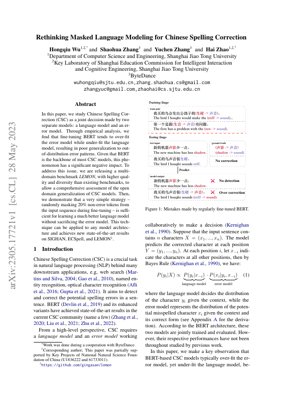
Chinese Spelling Correction (CSC) is a critical NLP task with applications in search, OCR, and text processing. The paper identifies a fundamental flaw in current state-of-the-art approaches, primarily those based on fine-tuning BERT. The core issue is an imbalance during fine-tuning: the model overfits to the error model (memorizing specific character substitution patterns seen in training) while underfitting the language model (failing to robustly learn contextual character distributions). This leads to poor generalization, especially for unseen error patterns or new domains, as illustrated by failures in correcting novel misspellings like "声影" (shadow) to "声音" (sound).
2. Theoretical Framework: The Joint Model
The paper frames CSC as a Bayesian decision made by two collaborative models. For an input sequence $X = (x_1, ..., x_n)$ and output $Y = (y_1, ..., y_n)$, the probability at position $i$ is:
$P(y_i | X) \propto \underbrace{P(y_i | x_{-i})}_{\text{Language Model}} \cdot \underbrace{P(x_i | y_i, x_{-i})}_{\text{Error Model}}$
This decomposition is crucial. The Language Model estimates what character $y_i$ is appropriate given the surrounding context $x_{-i}$. The Error Model estimates the likelihood of observing the potentially misspelled input $x_i$ given the correct character $y_i$ and the context.
2.1. The Language Model Component
This component is responsible for general linguistic fluency and coherence. A weak language model cannot leverage context to infer the correct character when faced with an unfamiliar error.
2.2. The Error Model Component
This component captures the noise process—how correct characters become misspelled (e.g., phonetic similarity, visual similarity). It is easier to memorize from limited training data, leading to the observed overfitting.
3. The Overfitting Problem & LEMON Benchmark
The paper provides empirical evidence that standard BERT fine-tuning excels at correcting seen error pairs but fails on unseen ones, demonstrating memorization over generalization. To rigorously evaluate this, the authors introduce LEMON, a new multi-domain benchmark for CSC. LEMON is designed with higher quality and diversity than existing benchmarks (like SIGHAN), specifically to stress-test the open-domain generalization capability of CSC models, addressing a key gap in the field's evaluation methodology.
4. Proposed Solution: Random Masking
The proposed fix is elegantly simple and architecture-agnostic. During fine-tuning, in addition to the original task, the model randomly masks 20% of non-error tokens in the input sequence. This technique, reminiscent of BERT's original pre-training objective, forces the model to continually practice and strengthen its language modeling capabilities on the task-specific data. It prevents the model from ignoring the context and relying solely on memorized error pairs, thereby better balancing the training of the joint model.
5. Experimental Results & Chart Explanation
The proposed method achieves new state-of-the-art results on SIGHAN, ECSpell, and the newly introduced LEMON benchmark. The key chart in the paper (Figure 1) visually demonstrates the failure mode of standard fine-tuning:
- Training Stage: The model learns pairs like "生硬 -> 声音" (stiff -> sound) and "生音 -> 声音" (raw -> sound).
- Testing Stage Failure 1 (No Detection): Given a novel error "声影" (shadow) in a fitting context ("新的机器声影少一点" - The new machine has less shadow/sound), the model fails to correct it to "声音". The underfit language model cannot use the context to infer "声音" is correct.
- Testing Stage Failure 2 (Over-correction): Given "生硬" (stiff) in a context where it is actually correct ("我买的鸟声音很生硬" - The bird I bought sounds stiff), the overfit error model incorrectly changes it to "声音", destroying the original meaning.
The results with random masking show significant improvement in handling such cases, proving better generalization.
6. Analytical Framework & Case Study
Framework for Diagnosing CSC Model Failures:
- Isolate the Error: Identify if the failure is a false positive (over-correction) or a false negative (missed error).
- Analyze the Error Pair: Check if the mistaken or missed $(x_i, y_i)$ pair was present in the training data.
- Evaluate Context Fit: Using a standalone language model (e.g., GPT), assess if the proposed correction $y_i$ makes sense in context $x_{-i}$.
- Diagnosis:
- False Negative on unseen pair + good context fit => Weak Language Model.
- False Positive on seen pair + poor context fit => Overfit Error Model.
Case Study (From Paper): Applying this to Figure 1: The missed "声影->声音" is an unseen pair, but "声音" fits the context ("machine has less sound"). Diagnosis: Weak Language Model. The over-correction "生硬->声音" is a seen pair, but "生硬" (stiff) actually fits its context ("bird sounds stiff"). Diagnosis: Overfit Error Model.
7. Future Applications & Directions
The implications extend beyond CSC:
- Grammar Error Correction (GEC): The joint model framework could be adapted, treating grammatical mistakes as "errors" on syntactic structures.
- Robust Fine-tuning Paradigm: The random masking strategy offers a general recipe for preventing task-specific overfitting in other NLP fine-tuning scenarios, similar to how dropout prevents overfitting in neural networks.
- Low-Resource & Cross-Domain Adaptation: Strengthening the language model component via masking could be particularly beneficial when adapting a model trained on one domain (e.g., news) to another (e.g., social media) with different error distributions.
- Integration with Large Language Models (LLMs): Future work could explore using the joint model principle to guide prompt engineering or fine-tuning of LLMs for specialized correction tasks, combining their powerful inherent language modeling with a learned error model.
8. References
- Devlin, J., Chang, M. W., Lee, K., & Toutanova, K. (2019). BERT: Pre-training of Deep Bidirectional Transformers for Language Understanding. NAACL-HLT.
- Wu, H., Zhang, S., Zhang, Y., & Zhao, H. (2023). Rethinking Masked Language Modeling for Chinese Spelling Correction. arXiv:2305.17721.
- Zhu, C., et al. (2022). A Survey of Chinese Spelling Correction. ACM Transactions on Asian and Low-Resource Language Information Processing.
- OpenAI. (2023). GPT-4 Technical Report. arXiv:2303.08774.
- Google AI. (2023). PaLM 2 Technical Report. Google Research.
9. Expert Analysis & Commentary
Core Insight: This paper delivers a surgical strike on a pervasive illusion in applied NLP: that fine-tuning a giant pre-trained model like BERT is a silver bullet. The authors convincingly argue that for structured prediction tasks like CSC, naive fine-tuning can catastrophically unbalance the model's internal components. The error model, being a simpler memorization task, hijacks the learning process, leaving the more complex, context-reasoning language model starved. This isn't just a minor performance hiccup; it's a fundamental architectural flaw in the standard approach that limits real-world deployment where error patterns are endlessly novel.
Logical Flow: The argument is impeccably constructed. First, they establish the theoretical lens—the Bayesian decomposition into language and error models. This isn't new (citing Kernighan et al., 1990), but its application to diagnose modern neural models is brilliant. Then, they provide the smoking gun: qualitative examples (Figure 1) that any practitioner has seen but perhaps dismissed as edge cases. The introduction of the LEMON benchmark is a masterstroke—it moves the goalposts from chasing leaderboard scores on narrow datasets to evaluating generalization, which is the true metric of utility. Finally, the solution is not another complex module or loss function, but a回归 (return) to the core pre-training principle of Masked Language Modeling (MLM). The elegance is in its simplicity: if the language model is weak, give it more language modeling practice during task-specific training.
Strengths & Flaws: The primary strength is the powerful, generalizable insight paired with a simple, effective fix. The 20% random masking heuristic is likely to become a standard trick in the CSC toolkit. The LEMON benchmark is a significant contribution to the field. However, the analysis has a flaw common to diagnostic papers: it points to the symptom (imbalance) and offers a treatment (masking), but doesn't deeply explore why the gradient dynamics of fine-tuning lead to this imbalance in the first place. Is it a data distribution issue, an optimization pathology, or an inherent property of the transformer architecture for this task? Furthermore, while the results are strong, the paper doesn't fully explore the limits of the masking approach—could adaptive masking rates or strategic masking of certain token types (e.g., content words vs. function words) yield further gains? As seen in the evolution of pre-training from static masking in BERT to dynamic masking in RoBERTa and span masking in SpanBERT, there's likely room for optimization here.
Actionable Insights: For AI product managers and engineers, this paper is a mandate. First, immediately integrate random masking of non-error tokens into your CSC model fine-tuning pipelines—it's low-cost and high-reward. Second, shift evaluation focus from in-domain test sets to cross-domain or challenge sets like LEMON to truly gauge robustness. Third, apply this diagnostic framework beyond CSC. Any sequence-to-sequence "correction" task—grammar correction, style transfer, code repair, document denoising—likely suffers from a similar joint model tension. Test if your model is memorizing transformation patterns rather than understanding context. The principle of reinforcing the core language model during task-specific training via auxiliary objectives (like masking) is a powerful meta-learning strategy. This work aligns with a broader trend in ML, exemplified by research from institutions like Google Brain and OpenAI, which emphasizes that robustness and generalization often come from training procedures that encourage models to develop deeper, more fundamental understanding rather than superficial pattern matching.