Table of Contents
- 1. Introduction & Overview
- 2. Experimental Procedure & Methodology
- 3. Inductive Biases in L2 Training Methods
- 4. Effects of L1 Training on L2 Grammar Acquisition
- 5. Process Analysis of L2 Acquisition
- 6. Core Insight & Analyst Perspective
- 7. Technical Details & Mathematical Framework
- 8. Experimental Results & Chart Interpretation
- 9. Analysis Framework: Example Case
- 10. Future Applications & Research Directions
- 11. References
1. Introduction & Overview
This research investigates the second language (L2) acquisition process in neural language models (LMs), shifting focus from the typical first language (L1) acquisition studies. The core question is how prior L1 knowledge influences the efficiency and nature of grammatical knowledge acquisition in a new language (L2). The study designs a human-like L2 learning scenario for bilingual LMs, pretraining them on an L1 (French, German, Russian, Japanese) before exposing them to English as the L2. The goal is to analyze cross-lingual transfer from a linguistic perspective, using grammatical judgment tests to evaluate generalization.
2. Experimental Procedure & Methodology
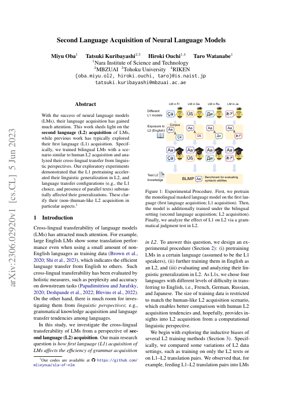
The methodology follows a three-stage pipeline, as conceptually illustrated in Figure 1 of the PDF:
- L1 Pretraining (First Language Acquisition): A monolingual masked language model (e.g., BERT architecture) is pretrained from scratch on a corpus of a single language (L1).
- L2 Training (Second Language Acquisition): The L1-pretrained model undergoes further training under a bilingual setting. This involves exposure to English (L2) data. Different configurations are tested, including L2-only monolingual texts and L1-L2 parallel translation pairs.
- Evaluation & Analysis: The model's linguistic generalization in L2 is evaluated using the BLiMP benchmark, which tests syntactic abilities. The effect of the L1 choice and training configuration is analyzed.
Training data size is intentionally restricted to simulate a more data-efficient, human-like learning scenario rather than the massive data regimes typical of modern LLMs.
3. Inductive Biases in L2 Training Methods
The study first explores how different ways of presenting L2 data affect learning. A key finding is that models trained on L1-L2 translation pairs showed slower L2 grammar acquisition compared to models trained on L2 monolingual texts presented intermittently (e.g., every two epochs). This suggests that direct translation exposure may introduce a confounding inductive bias or processing overhead that hinders pure L2 structural learning, a nuance with implications for designing multilingual training curricula.
4. Effects of L1 Training on L2 Grammar Acquisition
4.1 L1 Knowledge Promotes L2 Generalization
The primary finding is that pretraining on an L1 accelerates and improves linguistic generalization in the L2 (English), compared to a model learning English from scratch. This demonstrates positive transfer, where abstract linguistic representations learned from L1 are beneficial for acquiring L2.
4.2 Differential Effects of L1 Languages
The benefit of L1 pretraining is not uniform. Models with L1s linguistically closer to English (French, German) showed superior L2 generalization compared to those with more distant L1s (Japanese, Russian). This aligns with established human second language acquisition (SLA) theory, such as the Contrastive Analysis Hypothesis, and empirical data on language transfer difficulty (Chiswick & Miller, 2004).
4.3 Grammar-Specific Transfer Effects
Transfer gains varied across grammatical phenomena. The largest improvements from L1 pretraining were observed for morphological and syntactic items (e.g., subject-verb agreement, syntactic islands). Smaller gains were seen for semantic and syntax-semantic interface items (e.g., quantifier scope). This indicates that core structural knowledge transfers more readily than meaning-related constraints.
5. Process Analysis of L2 Acquisition
5.1 Progression of L2 Knowledge Acquisition
Analysis of the learning trajectory revealed two critical insights:
- Data Inefficiency: Significant L2 knowledge acquisition did not occur until the model had seen the entire L2 dataset many times (e.g., 50-100 epochs), highlighting a stark contrast with human ability to generalize from few examples.
- Catastrophic Interference / L1 Knowledge Degradation: During L2 training, the model's performance on its original L1 tasks degraded. This phenomenon, known as catastrophic forgetting in continual learning, underscores a key non-human-like aspect of current LMs and points to the need for mechanisms to balance source and target linguistic knowledge.
6. Core Insight & Analyst Perspective
Core Insight: This paper delivers a crucial, often overlooked truth: neural LMs are not magic multilingual learners; they are inefficient statistical memorizers whose "language acquisition" is heavily constrained by data distribution, architectural biases, and catastrophic forgetting. Their "positive transfer" mirrors human SLA only superficially, driven by overlapping statistical regularities rather than cognitive abstraction.
Logical Flow: The authors brilliantly deconstruct the LM language learning process into a controlled, human-analogous experiment (L1 pretrain → L2 exposure). This allows them to isolate variables like L1 typology and training regimen. The logical progression from exploring inductive biases (Sec 3) to measuring transfer effects (Sec 4) and finally diagnosing the learning process itself (Sec 5) is methodologically sound and revealing.
Strengths & Flaws: The study's strength is its rigorous, linguistics-grounded experimental design, moving beyond holistic metrics like perplexity. It provides granular, phenomenon-specific insights. However, its major flaw is scale. Using smaller, controlled data and model sizes is great for scientific isolation but limits direct applicability to today's frontier LLMs (GPT-4, Claude, Gemini) trained on trillion-token corpora. The observed effects might be amplified or diminished at scale. Furthermore, the analysis, while insightful, remains correlational; it doesn't pinpoint the mechanisms of transfer within the model's representations.
Actionable Insights: For practitioners, this research is a clarion call. First, curriculum design matters. Don't just dump parallel data; structured, monolingual-heavy L2 exposure might be more efficient initially, as hinted by the translation pair slowdown. Second, mind the linguistic distance. Transfer from Japanese to English will be harder than from German; allocate resources and set expectations accordingly. Third, catastrophic forgetting is a real product risk. Deploying a model fine-tuned on a new language without safeguards can degrade its original capabilities, a critical consideration for multi-region AI products. Companies should invest in continual learning techniques inspired by works like "Continual Lifelong Learning with Neural Networks: A Review" (Parisi et al., 2019) to mitigate this. Finally, for researchers, the paper lays a blueprint for more mechanistic interpretability work to understand how grammatical knowledge is encoded and transferred across linguistic boundaries within these models.
7. Technical Details & Mathematical Framework
The study likely employs a standard Masked Language Modeling (MLM) objective, as used in BERT. The core pretraining objective is to maximize the likelihood of reconstructing randomly masked tokens [MASK] given their context.
MLM Objective: For a sequence of tokens $X = (x_1, ..., x_T)$, a random subset of tokens (e.g., 15%) is masked, resulting in a corrupted sequence $\tilde{X}$. The model (parameterized by $\theta$) is trained to predict the original tokens at the masked positions:
$\mathcal{L}_{MLM}(\theta) = - \mathbb{E}_{X \sim \mathcal{D}} \sum_{i \in M} \log P_{\theta}(x_i | \tilde{X})$
where $M$ is the set of masked positions and $\mathcal{D}$ is the training data corpus (first L1, then L2).
Transfer Analysis Metric: The key evaluation metric is accuracy on the BLiMP benchmark. The analysis often involves comparing the performance delta ($\Delta Acc$) between an L1-pretrained model and a baseline model trained only on L2:
$\Delta Acc_{L1\rightarrow L2} = Acc_{Model(L1 + L2)} - Acc_{Model(L2\ only)}$
A positive $\Delta Acc$ indicates positive cross-lingual transfer.
8. Experimental Results & Chart Interpretation
While the provided PDF excerpt does not contain specific numerical charts, it describes the results that would typically be visualized:
- Figure 1 (Conceptual Diagram): Illustrates the three-stage experimental pipeline: different L1 models (Fr, Ge, Ja, Ru) undergoing L1 pretraining, then exposure to L2 (English), followed by testing on the BLiMP benchmark.
- Hypothetical Performance Curves: One would expect to see line graphs showing L2 (BLiMP) accuracy on the y-axis against L2 training epochs on the x-axis, with separate lines for each L1-pretrained model and an L2-only baseline. The curves for French and German models would likely rise faster and to a higher final plateau than Japanese and Russian models.
- Hypothetical Bar Charts: Bar charts comparing final BLiMP accuracy across models for different grammatical phenomena (morphology, syntax, semantics). Bars for the L1-pretrained models would be taller than the baseline, with the height difference (transfer gain) being largest for morphology/syntax bars.
- Forgetting Curve: A potential chart could show L1 task performance (y-axis) declining as L2 training epochs (x-axis) increase, demonstrating catastrophic interference.
9. Analysis Framework: Example Case
Scenario: Analyzing the transfer of knowledge about subject-verb agreement from French (L1) to English (L2).
Framework Application:
- Linguistic Alignment: Both French and English require subject-verb agreement in number (e.g., He walks / Il marche vs. They walk / Ils marchent). This structural similarity predicts high potential for positive transfer.
- Model Probing: After L1 pretraining, use a diagnostic classifier (probe) on the French model's hidden states to measure how well it represents the "agreement" feature. High accuracy indicates the feature is well-learned in L1.
- Transfer Measurement: After L2 training, evaluate the model on English agreement items in BLiMP (e.g., "The key on the cabinets *are/*is..."). Compare accuracy to a model without French L1 knowledge.
- Attribution Analysis: Use techniques like attention visualization or gradient-based attribution to see if the model uses similar neural pathways/subnetworks for solving agreement in English as it did in French.
Expected Outcome: The French-pretrained model should show superior and faster acquisition of English agreement rules, and probing may show the reactivation of the "agreement-detection" subnetwork learned during French pretraining.
10. Future Applications & Research Directions
- Efficient Multilingual Model Training: Informing data curation and training curricula for companies building LLMs for global markets (e.g., Meta, Google). Strategies could involve staged training starting with linguistically related language clusters.
- Personalized Language Learning Tools: AI tutors that adapt explanations and exercises based on a learner's L1, anticipating specific transfer errors (e.g., warning a Japanese speaker about English articles).
- Low-Resource Language NLP: Leveraging transfer from a related high-resource L1 to bootstrap models for extremely low-resource languages, a direction highlighted by research at institutions like the Allen Institute for AI.
- Neurolinguistics & Cognitive Modeling: Using LMs as testable models of human language acquisition hypotheses, potentially refining theories like the Unified Competition Model.
- Mitigating Catastrophic Forgetting: Developing more robust continual learning algorithms for LLMs, inspired by this study's observation of L1 degradation, ensuring stable multilingual capabilities.
- Mechanistic Interpretability: A major future direction is to move beyond performance correlations and use advanced interpretability tools (like those from Anthropic's research or OpenAI's microscope efforts) to identify the exact circuits and features that are transferred or interfered with during L2 learning.
11. References
- Oba, M., Kuribayashi, T., Ouchi, H., & Watanabe, T. (2023). Second Language Acquisition of Neural Language Models. arXiv preprint arXiv:2306.02920.
- Brown, T. B., et al. (2020). Language Models are Few-Shot Learners. Advances in Neural Information Processing Systems, 33, 1877-1901.
- Chiswick, B. R., & Miller, P. W. (2004). Linguistic Distance: A Quantitative Measure of the Distance Between English and Other Languages. Journal of Multilingual and Multicultural Development, 26(1), 1-11.
- Parisi, G. I., Kemker, R., Part, J. L., Kanan, C., & Wermter, S. (2019). Continual lifelong learning with neural networks: A review. Neural Networks, 113, 54-71.
- Warstadt, A., Singh, A., & Bowman, S. R. (2020). BLiMP: The Benchmark of Linguistic Minimal Pairs. Proceedings of the 58th Annual Meeting of the Association for Computational Linguistics.
- Papadimitriou, I., & Jurafsky, D. (2020). Pretraining on Non-English Data Improves Cross-lingual Generalization. Proceedings of the 1st Conference of the Asia-Pacific Chapter of the Association for Computational Linguistics.