Table of Contents
- 1. Introduction
- 2. Main Body
- 3. Key Insights & Core Framework
- 4. Experimental Results & Diagram Description
- 5. Analytical Framework: Example Case
- 6. Technical Details & Mathematical Formulation
- 7. Original Analysis & Critical Perspective
- 8. Future Applications & Development Directions
- 9. References
1. Introduction
This study aims to introduce a new model for teaching Chinese as a foreign language (TCFL) from the interdisciplinary perspective of Rongzhixue (Integrating Wisdom Studies). The background incorporates the latest findings in linguistic science, bilingual memory models, second language acquisition (SLA) theories, the interlanguage hypothesis, the "Seven-Times Mastery" method, and established TCFL principles. A core focus is the formal understanding of the relationship between "Yan" (language as system) and "Yu" (speech as performance), and the systemic engineering of cultural genes encompassing language, knowledge, software, hardware, teaching, management, learning, and application. The model's hallmark is its focus on a "butterfly model" prioritizing interpretation before translation, emphasizing novel methods for bilingual thinking training, and leveraging AI to empower both teaching and learning.
2. Main Body
2.1. Second Language Acquisition Theory
The model is grounded in established SLA theory, notably Krashen's five hypotheses (see Table 1). It acknowledges the distinction between subconscious "acquisition" and conscious "learning," emphasizing the primacy of acquisition while recognizing the monitoring role of learned knowledge. The model seeks to create conditions optimal for acquisition through comprehensible input while strategically employing the monitor for accuracy in production, especially in written or prepared speech.
2.2. The Butterfly Model: Interpretation Before Translation
The central pedagogical innovation is the "butterfly model." This model posits that effective language transfer, particularly for complex concepts, requires a phase of deep interpretation and understanding within the source language (or a metalanguage) before attempting direct translation. This process activates and trains bilingual conceptual frameworks rather than promoting superficial lexical substitution. One wing of the butterfly represents deconstruction and comprehension of meaning; the other represents reconstruction and expression in the target language.
2.3. AI-Empowered Teaching and Learning
The model explicitly integrates AI tools like ChatGPT. The proposed method involves a tripartite dialogue: 1) Learner-ChatGPT interaction in English, 2) Bilingual (English-Chinese) interaction facilitated by the AI and teacher, 3) Target-language (Chinese) interaction. This scaffolded approach uses AI as a tireless conversation partner and resource, accelerating exposure and practice. The teacher's role evolves to curate resources, guide the interpretation process within the butterfly model, and facilitate higher-order discussion.
2.4. The New Theory of Chinese Characters and Language
The model applies a "new theory of Chinese characters and language," which likely emphasizes the systematic, ideographic, and morphological properties of Chinese script, moving beyond rote memorization. Understanding the relationship between form, meaning, and sound (形、义、音) is central. This theoretical foundation informs the creation of teaching resources that help learners perceive patterns, aiding literacy acquisition and deepening metalinguistic awareness.
3. Key Insights & Core Framework
Core Insight: The fundamental shift is from teaching Chinese as a static code to be memorized to cultivating a dynamic, bilingual thinking capacity. The goal is cognitive flexibility, not just linguistic accuracy.
Framework Components: 1) Rongzhixue Lens: Interdisciplinary integration of linguistics, cognitive science, pedagogy, and AI. 2) Butterfly Model Pedagogy: Interpretation → Understanding → Translation/Production. 3) AI Tripartite Dialogue: L2 → Bilingual Bridge → L1. 4) Theory-Informed Resources: Materials based on the structural logic of Chinese.
4. Experimental Results & Diagram Description
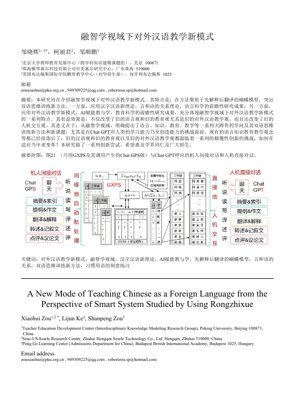
The paper references an abstract diagram (Figure 21) illustrating "indirect machine-human dialogue and direct human-machine dialogue echoing ChatGPT by skillfully using GXPS and the ChatGPS it invokes." This suggests a practical experiment where a custom system (GXPS/ChatGPS) acts as an intermediary or co-pilot with ChatGPT. The expected result, implied by the model, is a more structured and pedagogically effective interaction than raw ChatGPT use, leading to improved fluency and accuracy in learners' Chinese output through the guided, multi-stage dialogue process. The diagram likely visualizes the flow of conversation between learner, intermediary AI, and primary AI (ChatGPT).
5. Analytical Framework: Example Case
Scenario: Teaching the Chinese idiom "画蛇添足" (huà shé tiān zú, "to draw legs on a snake" – to ruin by adding superfluous details).
Traditional Approach: Provide translation and example sentence.
New Model Approach:
1. Interpretation (Butterfly Wing A): Use English/AI dialogue to explore the concept of "unnecessary addition that spoils something." Discuss analogous English idioms ("gild the lily," "over-egg the pudding"). Establish deep conceptual understanding.
2. Translation/Production (Butterfly Wing B): Introduce the Chinese idiom. Analyze characters: 画 (draw), 蛇 (snake), 添 (add), 足 (foot/leg). Connect the literal image to the established concept.
3. AI Tripartite Dialogue: Learner practices with ChatGPT: a) Discusses the concept in English. b) Asks for bilingual examples. c) Attempts to use the idiom in a Chinese sentence, receiving feedback.
4. Deliberate Practice: Learner is tasked with identifying or creating scenarios where "画蛇添足" applies, reinforcing the bilingual concept-meaning link.
6. Technical Details & Mathematical Formulation
While the PDF does not present explicit formulas, the underlying cognitive model can be conceptualized. The transition from superficial translation to deep interpretation aligns with minimizing semantic loss. If $M_s$ is the meaning vector in the source language conceptual space, and $M_t$ is the target language meaning vector, direct word-for-word translation attempts a mapping $T_{direct}: M_s \rightarrow M_t$ which often incurs high loss $L_{direct}$. The butterfly model introduces an intermediate, language-agnostic conceptual representation $C$.
$\text{Stage 1 (Interpretation): } I: M_s \rightarrow C$
$\text{Stage 2 (Production): } P: C \rightarrow M_t$
The total process is $P(I(M_s))$. The pedagogical aim is to train the functions $I$ (interpretation) and $P$ (production) such that the composite loss $L_{total} = L_{interpret} + L_{produce}$ is less than $L_{direct}$. AI interaction provides high-frequency training data for refining $I$ and $P$.
7. Original Analysis & Critical Perspective
Core Insight: This paper isn't just about teaching Chinese; it's a provocative blueprint for post-ChatGPT pedagogy. It correctly identifies that if AI can generate fluent text, human education must pivot towards cultivating the deeper cognitive architecture—bilingual conceptual mapping and critical interpretation—that AI currently lacks. The proposed model is essentially a human-AI co-evolution strategy for language learning.
Logical Flow: The argument starts from the crisis (traditional models are obsolete), posits a new theoretical foundation (Rongzhixue, new character theory), introduces a core method (Butterfly Model), and deploys a practical tool (AI tripartite dialogue). The flow from theory to practice is clear.
Strengths & Flaws: Its greatest strength is its timeliness and holistic vision, marrying cognitive theory with practical AI application. It moves beyond the simplistic "ChatGPT as tutor" idea to a more structured collaborative framework. However, the paper's flaw is its vagueness. "Rongzhixue" and the "new theory of Chinese characters" are presented as axiomatic rather than rigorously defined or contrasted with existing theories (e.g., Cognitive Linguistics, Construction Grammar). Where is the empirical data? Claims about accelerated progress and superior cost-benefit are unsubstantiated. The model risks being a compelling manifesto rather than a validated methodology.
Actionable Insights: For educators and researchers, the takeaway is to operationalize and test this vision. 1) Define Metrics: How do we measure "bilingual thinking capacity" versus mere proficiency? 2) Build the Tools: The GXPS/ChatGPS intermediary hinted at in Figure 21 needs to be developed and open-sourced to replicate the method. 3) Conduct RCTs: Compare outcomes (speed, accuracy, conceptual transfer) against established communicative or immersive methods. 4) Engage with Existing Literature: Ground the "butterfly model" in related work like Paivio's Dual Coding Theory or Kecskes' Socio-Cognitive Approach to pragmatics. As noted by researchers at the MIT Integrated Learning Initiative, the future of learning lies in redesigning curricula around human-computer collaboration, not just computer assistance. This paper points in that direction but requires concrete, falsifiable next steps to move from proposal to paradigm.
8. Future Applications & Development Directions
1. Platform Development: Creating dedicated platforms that operationalize the butterfly model and tripartite AI dialogue, integrating tools for deliberate practice of idioms and patterns.
2. Curriculum Design: Developing full curricula based on this model for different learner levels, moving from topic-based to concept-and-thinking-based syllabi.
3. Teacher Training: New professional development programs to equip teachers with skills to facilitate AI-mediated, interpretation-focused classrooms.
4. Cross-Linguistic Adaptation: Applying the model's principles (not the Chinese-specific theory) to other language pairs, especially those with high linguistic distance.
5. Neuroscientific Validation: Using fMRI or EEG to study the brain activity of learners using this method versus traditional methods, seeking correlates of "bilingual thinking."
6. Advanced AI Integration: Moving beyond conversational AI to integrate multimodal AI (analysing tone, handwriting) and AI that can generate personalized learning pathways based on real-time interpretation gaps.
9. References
- Krashen, S. D. (1982). Principles and Practice in Second Language Acquisition. Pergamon Press.
- Kecskes, I. (2014). Intercultural Pragmatics. Oxford University Press.
- Paivio, A. (1990). Mental Representations: A Dual Coding Approach. Oxford University Press.
- MIT Integrated Learning Initiative. (2023). Research on the Future of Learning and Technology. Retrieved from [MITili website].
- Zou, X., Ke, L., & Zou, S. (2023). A New Mode of Teaching Chinese as a Foreign Language from the Perspective of Smart System Studied by Using Rongzhixue. [Source PDF].
- Zhu, Y., & Li, L. (2022). AI in Language Education: A Review of Recent Developments and Future Directions. Computer Assisted Language Learning, 35(8), 1234-1256.