Table of Contents
- 1. Introduction & Core Problem
- 2. Tsarin Ka'idar: Haɗin Samfurin
- 2.1. Bangaren Samfurin Harshe
- 2.2. Bangaren Samfurin Kuskure
- 3. The Overfitting Problem & LEMON Benchmark
- 4. Shawarar da aka Gabatar: Rufe da Bazuwar
- 5. Experimental Results & Analysis
- 6. Analytical Framework & Case Study
- 7. Future Applications & Directions
- 8. Nassoshi
- 9. Expert Analysis & Commentary
1. Introduction & Core Problem
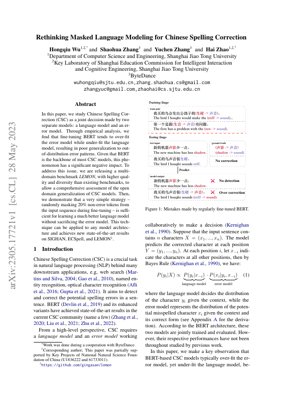
Chinese Spelling Correction (CSC) aiki ne mai mahimmanci na NLP tare da aikace-aikace a cikin bincike, OCR, da sarrafa rubutu. Takardar ta gano aibi na asali a cikin hanyoyin zamani na yanzu, da farko waɗanda suka dogara da daidaita BERT. Matsala ta asali ita ce rashin daidaito yayin daidaitawa: samfurin ya wuce gona da iri ga samfurin kuskure (memorizing specific character substitution patterns seen in training) while underfitting the language model (failing to robustly learn contextual character distributions). This leads to poor generalization, especially for unseen error patterns or new domains, as illustrated by failures in correcting novel misspellings like "shadow" to "sound".
2. Tsarin Ka'idar: Haɗin Samfurin
The paper frames CSC as a Bayesian decision made by two collaborative models. For an input sequence $X = (x_1, ..., x_n)$ and output $Y = (y_1, ..., y_n)$, the probability at position $i$ is:
$P(y_i | X) \propto \underbrace{P(y_i | x_{-i})}_{\text{Language Model}} \cdot \underbrace{P(x_i | y_i, x_{-i})}_{\text{Error Model}}$
This decomposition is crucial. The Language Model estimates what character $y_i$ is appropriate given the surrounding context $x_{-i}$. The Error Model estimates the likelihood of observing the potentially misspelled input $x_i$ given the correct character $y_i$ and the context.
2.1. Bangaren Samfurin Harshe
This component is responsible for general linguistic fluency and coherence. A weak language model cannot leverage context to infer the correct character when faced with an unfamiliar error.
2.2. Bangaren Samfurin Kuskure
This component captures the noise process—how correct characters become misspelled (e.g., phonetic similarity, visual similarity). It is easier to memorize from limited training data, leading to the observed overfitting.
3. The Overfitting Problem & LEMON Benchmark
The paper provides empirical evidence that standard BERT fine-tuning excels at correcting seen error pairs but fails on unseen ones, demonstrating memorization over generalization. To rigorously evaluate this, the authors introduce LEMON, a new multi-domain benchmark for CSC. LEMON is designed with higher quality and diversity than existing benchmarks (like SIGHAN), specifically to stress-test the open-domain generalization capability of CSC models, addressing a key gap in the field's evaluation methodology.
4. Shawarar da aka Gabatar: Rufe da Bazuwar
The proposed fix is elegantly simple and architecture-agnostic. During fine-tuning, in addition to the original task, the model randomly masks 20% of non-error tokens in the input sequence. This technique, reminiscent of BERT's original pre-training objective, forces the model to continually practice and strengthen its language modeling capabilities on the task-specific data. It prevents the model from ignoring the context and relying solely on memorized error pairs, thereby better balancing the training of the joint model.
5. Experimental Results & Chart Explanation
The proposed method achieves new state-of-the-art results on SIGHAN, ECSpell, and the newly introduced LEMON benchmark. The key chart in the paper (Figure 1) visually demonstrates the failure mode of standard fine-tuning:
- Training Stage: The model learns pairs like "生硬 -> 声音" (stiff -> sound) and "生音 -> 声音" (raw -> sound).
- Testing Stage Failure 1 (No Detection): Given a novel error "shadow" in a fitting context ("The new machine has less shadow/sound"), the model fails to correct it to "sound". The underfit language model cannot use the context to infer "sound" is correct.
- Testing Stage Failure 2 (Over-correction): Given "stiff" in a context where it is actually correct ("The bird I bought sounds stiff"), the overfit error model incorrectly changes it to "sound", destroying the original meaning.
The results with random masking show significant improvement in handling such cases, proving better generalization.
6. Analytical Framework & Case Study
Framework for Diagnosing CSC Model Failures:
- Isolate the Error: Identify if the failure is a false positive (over-correction) or a false negative (missed error).
- Bincika Kuskuren Biyu: Duba ko kuskuren ko kuskuren da aka yi kuskure ko aka rasa $(x_i, y_i)$ biyu ya kasance a cikin bayanan horo.
- Kimanta Dacewar Mahallin: Ta amfani da tsarin harshe mai zaman kansa (misali, GPT), kimanta ko gyaran da aka gabatar $y_i$ yana da ma'ana a cikin mahallin $x_{-i}$.
- Bincike:
- Kuskuren Karye mara gaskiya akan ba a gani ba pair + good context fit => Weak Language Model.
- False Positive on seen pair + poor context fit => Overfit Error Model.
Case Study (From Paper): Applying this to Figure 1: The missed "声影->声音" is an ba a gani ba pair, but "声音" fits the context ("machine has less sound"). Bincike: Weak Language Model. The over-correction "生硬->声音" is a seen pair, but "生硬" (stiff) actually fits its context ("bird sounds stiff"). Bincike: Overfit Error Model.
7. Future Applications & Directions
Tasirin ya wuce CSC:
- Grammar Error Correction (GEC): Tsarin haɗin gwiwar samfuri zai iya daidaitawa, yana ɗaukar kurakuran nahawu a matsayin "kurakurai" akan tsarin haɗin kalmomi.
- Tsarin Daidaitawa Mai Ƙarfi: Dabarar rufe bazuwar tana ba da girki na gabaɗaya don hana wuce gona da iri na musamman a wasu yanayin daidaitawar NLP, kama da yadda zubar da bayanai ke hana wuce gona da iri a cikin hanyoyin sadarwar jijiyoyi.
- Low-Resource & Cross-Domain Adaptation: Ƙarfafa ɓangaren samfurin harshe ta hanyar rufewa na iya zama da amfani musamman lokacin daidaita samfurin da aka horar da shi akan wani yanki (misali, labarai) zuwa wani (misali, kafofin watsa labarun zamantakewa) tare da rarraba kurakurai daban-daban.
- Integration with Large Language Models (LLMs): Future work could explore using the joint model principle to guide prompt engineering or fine-tuning of LLMs for specialized correction tasks, combining their powerful inherent language modeling with a learned error model.
8. Nassoshi
- Devlin, J., Chang, M. W., Lee, K., & Toutanova, K. (2019). BERT: Pre-training of Deep Bidirectional Transformers for Language Understanding. NAACL-HLT.
- Wu, H., Zhang, S., Zhang, Y., & Zhao, H. (2023). Rethinking Masked Language Modeling for Chinese Spelling Correction. arXiv:2305.17721.
- Zhu, C., et al. (2022). A Survey of Chinese Spelling Correction. ACM Transactions on Asian and Low-Resource Language Information Processing.
- OpenAI. (2023). GPT-4 Technical Report. arXiv:2303.08774.
- Google AI. (2023). PaLM 2 Technical Report. Google Research.
9. Expert Analysis & Commentary
Core Insight: This paper delivers a surgical strike on a pervasive illusion in applied NLP: that fine-tuning a giant pre-trained model like BERT is a silver bullet. The authors convincingly argue that for structured prediction tasks like CSC, naive fine-tuning can catastrophically unbalance the model's internal components. The error model, being a simpler memorization task, hijacks the learning process, leaving the more complex, context-reasoning language model starved. This isn't just a minor performance hiccup; it's a fundamental architectural flaw in the standard approach that limits real-world deployment where error patterns are endlessly novel.
Logical Flow: The argument is impeccably constructed. First, they establish the theoretical lens—the Bayesian decomposition into language and error models. This isn't new (citing Kernighan et al., 1990), but its application to diagnose modern neural models is brilliant. Then, they provide the smoking gun: qualitative examples (Figure 1) that any practitioner has seen but perhaps dismissed as edge cases. The introduction of the LEMON benchmark is a masterstroke—it moves the goalposts from chasing leaderboard scores on narrow datasets to evaluating generalization, which is the true metric of utility. Finally, the solution is not another complex module or loss function, but a regression (return) to the core pre-training principle of Masked Language Modeling (MLM). The elegance is in its simplicity: if the language model is weak, give it more language modeling practice during task-specific training.
Strengths & Flaws: Ƙarfin farko shine ƙwaƙƙwaran fahimta mai fa'ida, tare da sauƙin gyara mai inganci. Duk da yake ba a bayyana ainihin dalilin da ya sa hakan ya faru ba, ƙa'idar rufe kashi 20% na bazuwar tana iya zama dabara ta yau da kullum a cikin kayan aikin CSC. Ma'auni na LEMON gudummawa ce mai mahimmanci ga fannin. Duk da haka, binciken yana da aibi da ya zama ruwan dare ga takardun bincike: yana nuna alamar (rashin daidaito) kuma yana ba da magani (rufe), amma bai bincika sosai ba dalilin da ya sa yanayin gradient na daidaitawa ya haifar da wannan rashin daidaito tun da farko. Shin matsala ce ta rarraba bayanai, cuta ta ingantawa, ko kuma dabi'ar asali na tsarin transformer don wannan aikin? Bugu da ƙari, duk da yake sakamakon yana da ƙarfi, takardar ba ta bincika iyakokin hanyar rufe ba—shin ƙimar rufe daidaitacce ko rufe dabara na wasu nau'ikan alama (misali, kalmomin abun ciki da kalmomin aiki) zai iya samun ƙarin riba? Kamar yadda aka gani a cikin juyin halittar koyon aiki daga rufe tsaye a cikin BERT zuwa rufe mai ƙarfi a cikin RoBERTa da rufe iyaka a cikin SpanBERT, akwai yuwuwar sararin ingantawa a nan.
Abubuwan Fahimta Masu Aiki: Ga manajoji da injiniyoyin samfurin AI, wannan takarda wajibi ce. Na farko, nan da nan haɗa rufe bazuwar na kalmomin da ba kuskure ba cikin hanyoyin daidaitawar samfurin CSC—yana da ƙarancin farashi kuma yana da babbar lada. Na biyu, Shift evaluation focus from in-domain test sets to cross-domain or challenge sets like LEMON to truly gauge robustness. Third, Apply this diagnostic framework beyond CSC. Any sequence-to-sequence "correction" task—grammar correction, style transfer, code repair, document denoising—likely suffers from a similar joint model tension. Test if your model is memorizing transformation patterns rather than understanding context. The principle of reinforcing the core language model during task-specific training via auxiliary objectives (like masking) is a powerful meta-learning strategy. This work aligns with a broader trend in ML, exemplified by research from institutions like Google Brain and OpenAI, which emphasizes that robustness and generalization often come from training procedures that encourage models to develop deeper, more fundamental understanding rather than superficial pattern matching.